
Reliance Fire Protection Systems provides deluge system design, supply, installation, testing, commissioning, upgrades and AMC support for high-hazard industrial facilities across Indian states and major industrial locations.
A deluge system uses open sprinklers or spray nozzles connected to piping controlled by a deluge valve. When the detection or release arrangement operates, the valve admits water to the network and all open discharge devices in the protected zone operate together.
This rapid, simultaneous application makes deluge protection suitable for hazards where fire can grow or spread quickly. Relifire supports new systems, extensions, retrofits, valve replacement, detection and release interfaces, testing and preventive maintenance.
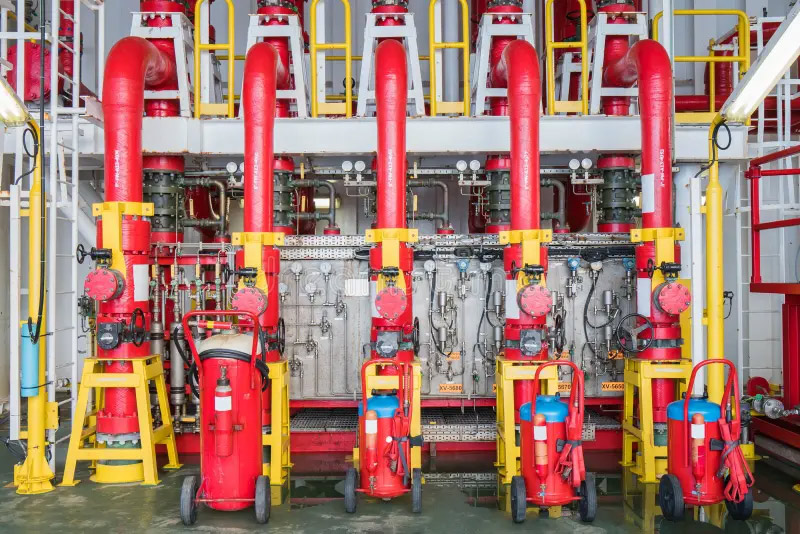
Valve, trim, isolation, pressure gauges, alarms, test and drain arrangements, manual release and supervised accessories for the protected zone.
Heat, smoke, flame, linear heat, pneumatic or other suitable detection connected to releasing controls and required plant interfaces.
Hydraulically engineered piping and open sprinklers or directional spray nozzles arranged to deliver water to the defined hazard area.
Valve trip tests, alarm verification, detection testing, nozzle inspection, obstruction checks, water-supply review and corrective maintenance.
Engineering and service support is available across India, subject to hazard details, site survey, project scope, authority requirements and logistics.
A deluge installation is not simply a valve connected to open sprinklers. It requires the correct water source, pumps where applicable, hydraulic demand, pipe sizing, nozzle orientation, structural supports, drainage, detection and release controls, alarms, shutdown interfaces and safe testing arrangements.
Where foam concentrate, water spray cooling or exposure protection is required, the complete hazard strategy and system compatibility must be evaluated during engineering.
Review fuel, equipment geometry, fire growth, exposure, water supply, drainage, environmental conditions and release requirements.
Prepare hydraulic calculations, discharge arrangement, piping, valve station, detection logic, controls and bill of materials.
Coordinate valve, piping, nozzles, detection, controls, alarms and interfaces followed by flushing, testing and commissioning.
Provide periodic inspection, valve trip tests, alarm checks, release testing, nozzle review, repairs and documentation support.
It uses open discharge devices connected to piping controlled by a deluge valve. When the release arrangement operates, water enters the network and discharges through all open outlets in the protected zone.
Yes. Relifire supports state-wise design, supply, installation, testing, commissioning, upgrades and AMC enquiries across India.
Wet sprinkler piping remains filled with water and individual closed sprinklers operate from heat. A deluge network uses open outlets, with water admitted when the deluge valve releases.
Typical applications include transformers, cable galleries, conveyors, tank farms, loading areas, process equipment, aircraft hangars and other rapidly developing hazards.
Yes, suitable listed detection and releasing arrangements may be used depending on the hazard, system design, environmental conditions and approval requirements.
Yes. Valves, trim, detection, release devices, alarms, water supply, nozzles, piping, drains and interfaces require documented inspection and testing.
Share your city, protected equipment, hazard details, available water supply, drawings and required project scope for design, supply, installation, testing, commissioning or AMC support.
Oxygen Reduction System
Hypoxic Fire Safety system
Hypoxic Air Protection
Hypoxic Fire Prevention System
Server Room Fire Protection System
IT Room Fire Protection System
Data Center Fire Protection
AI Fire Suppression Systems
AI Fire Protection Smoke Detector
AI Fire Alarm System
AI Based Fire Protection System Project
Oxygen Fire Protection Systems
Fire Prevention system
Ai thermal camera for critical environment
Industrial UVIR Detectors
Infrared camera fire thermal
Thermal Fire Camera
Battery Fire
Flame Detector
Spark Detector
Warehouse Oxygen Reduction System
Heritage Building Fire Protection
Museum Fire Protection System
Auto Mobile Fire Safety System
IoT-based Fire Safety Systems
Passive Fire Doors
Passive Fire Protection Tunnel System
Railway Fire Fighting Systems
Deluge System
Fire And Safty Audits
Fire Contractor
Fire Alarm
Fire Extinguisher
Jet Monitor Fire Fighting
Wet Sprinkler
Foam/Rim Seal Protection
High Velocity Water Spray System
Low Velocity Water Spray System
Vehicle Fire Safety
Fire Pressurisation System
Auto Cad Design & Estimation
Detail Engineering for complete Site
Design Consultancy as required
Aerosol Extinguishing System
Co2 flooding system
FM-200 Fire Suppression Systems
NOVEC-1230
Inert Gases
LT/HT Panel Gas Flooding System
Gas Leak Detection
Fire Evacuation Maps
Very Early Smoke Detection VESDA
Nuclear Fire Detection System
Linear Heat Sensing Detection
Pollution Wipe Box for Aviation Industries
Project Management
Mock Drills
Fire Safety Training
Advance Fire System
Lithium-Ion Battery Fire Protection
Energy Storage Fire Protection System
EV Fire Suppression Systems
Fire Consultancy Services
Honeywell Fire Alarm Systems
Oxygen Sensors for Data Centers & Server Rooms
Smoke Curtain System
UL / EN Fire Curtain System
Water Curtain System
Tunnel Fire Protection System
Simplex Fire Alarm Systems
Self-Test Smoke Detectors
IG541 Fire Gas Suppression System
Bosch Fire Alarm Systems
Fire Suppression
Fire Hydrant
Electrical Panel Gas Flooding System
Fire Fighting Mask
Vermiculite Fire Spray
fire protection contractor license
Oxygen sensors for data centers and server rooms
Warehouse Fire Protection
Fire Safety Budget Estimation
Fire Fighting Project Design Services
Bus Fire Protection – Engine & Water Mist
Data Center Fire Protection Contractors