Fire-water storage
Dedicated tanks, reservoirs, suction arrangements, level monitoring and refill provisions sized for the approved design basis.

Turnkey water-based fire protection for buildings and industrial sites
Survey, hydraulic design coordination, supply, installation, testing, commissioning and maintenance of pump, tank, ring-main, yard-hydrant, wet-riser and hose-reel systems.
A fire hydrant system is a fixed water-based firefighting network comprising a dedicated water supply, fire pumps, piping, valves, yard hydrants or landing valves, hoses and nozzles that trained responders use to control a fire.
The system must deliver the required flow and residual pressure at the hydraulically demanding outlets for the specified operating duration. Design therefore considers occupancy, hazard, simultaneous demand, water storage, pump duty, pipe losses, building height, hydrant spacing, access and authority requirements.
Reliance Fire Protection Systems provides turnkey fire hydrant system support from Mumbai for commercial, residential, industrial and infrastructure projects across India.
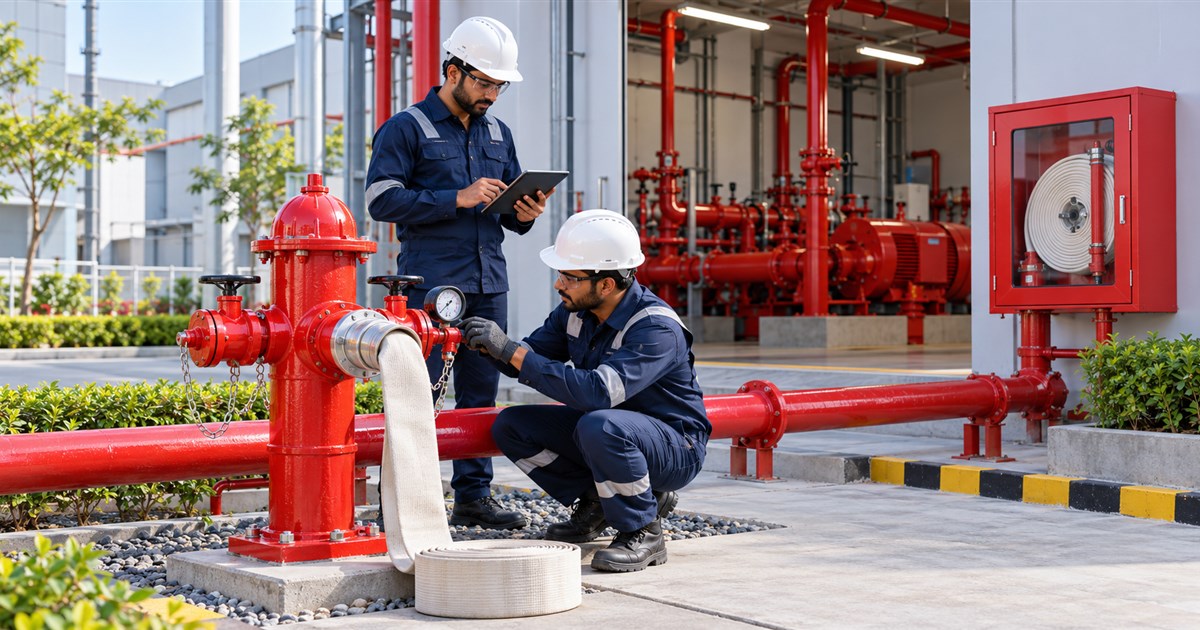
Dedicated tanks, reservoirs, suction arrangements, level monitoring and refill provisions sized for the approved design basis.
Electric main pump, diesel standby pump, jockey pump, controllers, batteries, fuel, test return and suction or delivery accessories.
Underground or above-ground fire-water mains, wet risers, supports, isolation valves, drains, air release and identification.
Outdoor hydrants and building landing valves arranged for safe access, hose deployment and required area coverage.
Hose reels, hoses, couplings, branch pipes, nozzles, cabinets, keys, spanners, signage and related accessories.
Breeching inlets or fire-department connections, non-return arrangements and accessible external interfaces where required.
| Design element | Key engineering consideration | Typical verification |
|---|---|---|
| Water storage | Required duration, effective capacity, refill, suction levels and separation from other uses | Capacity and usable-volume review |
| Fire pumps | Duty flow and pressure, redundancy, power, diesel fuel, controllers and automatic starting | Performance and sequence test |
| Pipe network | Material, diameter, routing, hydraulic loss, supports, corrosion protection and sectional isolation | Hydraulic calculation and pressure test |
| Hydrants and landing valves | Spacing, access, elevation, hose reach, pressure, cabinets and protection from damage | Outlet flow and residual pressure |
| System interfaces | Tank levels, pump status, alarms, remote monitoring and fire-brigade access | Integrated cause-and-effect test |
Offices, IT parks, malls, hotels, mixed-use developments and corporate campuses.
Factories, process plants, engineering units, utilities, warehouses and logistics facilities.
High-rise towers, housing societies, gated communities and common-area infrastructure.
Hospitals, laboratories, schools, colleges and institutional campuses.
Transport terminals, depots, utility buildings, tunnels and major development projects.
Data centres, power facilities, museums, archives and business-critical properties.
Survey, design coordination, supply, installation, testing, commissioning and maintenance support are available across all Indian states and union territories, subject to project scope and local approvals.
It is a fixed water-based firefighting network with a dedicated water supply, pumps, piping, valves, hydrants or landing valves, hoses and nozzles.
Typical components include tanks, electric and diesel pumps, jockey pump, controllers, ring mains, hydrants, landing valves, wet risers, hose reels, hoses, nozzles and brigade connections.
A yard hydrant is generally installed outdoors on a ring main; a landing valve is commonly installed on building wet-riser piping. Both provide hose connections.
Design considers hazard, codes, flow, pressure, duration, tank capacity, pump duty, simultaneous operation, pipe losses, spacing, access and approvals.
Testing can include pipe pressure, flushing, pump performance, automatic starting, valve operation, static and residual pressure, outlet flow, alarms and controls.
Yes. Pumps, tanks, controllers, valves, gauges, hydrants, landing valves, hose reels, hoses and piping require planned inspection and testing.
Yes. Reliance Fire Protection Systems supports hydrant projects across Indian states and union territories.
Share the location, occupancy, built-up area, building height, hazard, drawings, available water supply, approval requirements and project stage.
Call +91 96999 90424 | sales@relifire.com | Contact Reliance Fire Protection Systems