Rapid detection and release
Smoke or heat detectors, cross-zoned logic, a releasing control panel, audible and visual alarms, manual release and abort functions provide a coordinated response.

Turnkey gaseous fire suppression
An FM 200 fire suppression system is an engineered total-flooding solution for enclosed spaces containing sensitive equipment and business-critical assets. Reliance Fire Protection Systems provides design, supply, installation, testing, commissioning and maintenance support in Mumbai and across India.
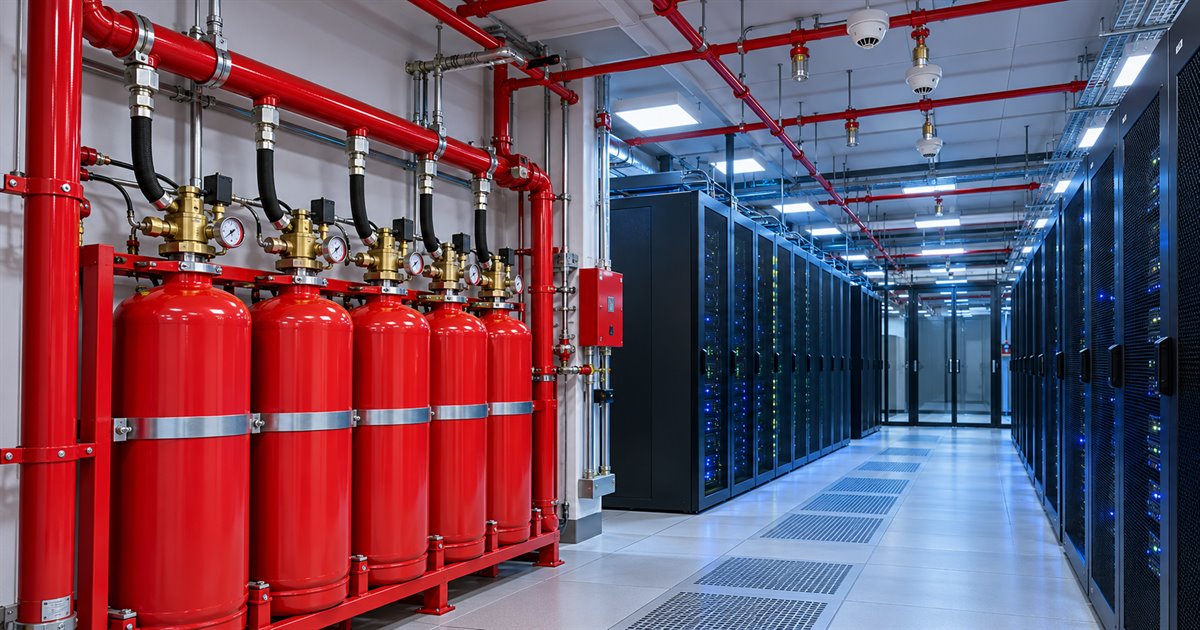
An FM 200 fire system uses HFC-227ea, commonly known by the FM-200 trade name, to suppress fire rapidly in a protected enclosure. The agent is electrically non-conductive and leaves no residue. A correctly designed system detects the incident, warns occupants, performs programmed equipment interfaces and discharges the calculated agent quantity through engineered piping and nozzles.
Smoke or heat detectors, cross-zoned logic, a releasing control panel, audible and visual alarms, manual release and abort functions provide a coordinated response.
Cylinder sizing, pipe calculations, nozzle selection and discharge layout are based on the hazard, enclosure volume, temperature, altitude and approved system criteria.
FM-200 does not leave powder or water residue after discharge, making it suitable for many enclosed areas that contain electronics, records or valuable equipment.
FM 200 fire extinguisher: The term may refer to portable extinguishing equipment using HFC-227ea, while a fixed FM-200 system is an engineered total-flooding installation. Portable-equipment selection must be based on certified ratings, the actual hazard and applicable local requirements.
We undertake project-based FM-200 design, supply, installation, testing, commissioning and maintenance for eligible sites throughout India. Final project coverage depends on survey requirements, equipment availability, logistics and local approvals.
Maharashtra, Gujarat, Goa, Rajasthan, Madhya Pradesh, Chhattisgarh, and Dadra and Nagar Haveli and Daman and Diu.
Karnataka, Tamil Nadu, Telangana, Andhra Pradesh, Kerala, Puducherry and Lakshadweep.
Delhi NCR, Haryana, Punjab, Uttar Pradesh, Uttarakhand, Himachal Pradesh, Chandigarh, Jammu and Kashmir, and Ladakh.
West Bengal, Odisha, Bihar, Jharkhand, Assam, Arunachal Pradesh, Manipur, Meghalaya, Mizoram, Nagaland, Sikkim and Tripura.
Andaman and Nicobar Islands, subject to shipping feasibility, project size and planned service support.
Mumbai, Navi Mumbai, Thane, Pune, Nashik, Nagpur, Kolhapur and Chhatrapati Sambhajinagar.
Ahmedabad, Gandhinagar, Vadodara, Surat, Rajkot, Ankleshwar, Vapi, Jaipur, Udaipur, Jodhpur and Kota.
Bengaluru, Mysuru, Mangaluru, Chennai, Coimbatore, Hosur, Madurai, Hyderabad, Secunderabad, Visakhapatnam, Vijayawada, Kochi, Thiruvananthapuram and Kozhikode.
Delhi, Gurugram, Noida, Greater Noida, Faridabad, Ghaziabad, Chandigarh, Mohali, Dehradun, Lucknow, Kanpur, Agra, Varanasi and Prayagraj.
Indore, Bhopal, Raipur, Bhilai, Kolkata, Howrah, Bhubaneswar, Cuttack, Ranchi, Jamshedpur, Patna and Guwahati.
It is an engineered gaseous suppression system using HFC-227ea. It discharges into an enclosed risk, absorbs heat from the fire and suppresses combustion without leaving residue.
Typical applications include server rooms, data centers, telecom rooms, electrical and control rooms, archives and other enclosed spaces containing valuable or sensitive equipment.
A total-flooding system depends on the enclosure retaining its design concentration for the required period. Enclosure review, leakage control and room-integrity testing are important during commissioning and maintenance.
Yes. We provide project-based design, supply, installation, testing, commissioning and maintenance support in Mumbai and major cities and states across India.
Share the protected-room dimensions, layout, ceiling and floor voids, ventilation details, occupancy and project location for a site-specific review.
Call: +91 96999 90424 | Email: sales@relifire.com