Cabinet and hazard survey
Review dimensions, equipment, internal partitions, ignition hazards, ventilation and installation constraints.

Hazard-specific suppression for electrical enclosures
Electrical cabinet fire protection enquiries for surveys, suitable suppression, detection, controls, installation and service, with the scope defined for the actual panel and operating conditions.
A panel flooding system is a fire suppression arrangement designed for a defined electrical cabinet or enclosure hazard. It may use a suitable extinguishing agent with detection and discharge components selected for the enclosure, equipment, ventilation and accepted design requirements.
Reliance Fire Protection Systems supports surveys, design coordination, equipment supply, installation, testing, audit and maintenance enquiries from Mumbai for project locations across India.
Panel protection must be selected as a complete working arrangement. Cabinet geometry, internal equipment, partitions, openings, airflow, electrical interfaces and occupied surroundings determine whether a proposed system is appropriate.
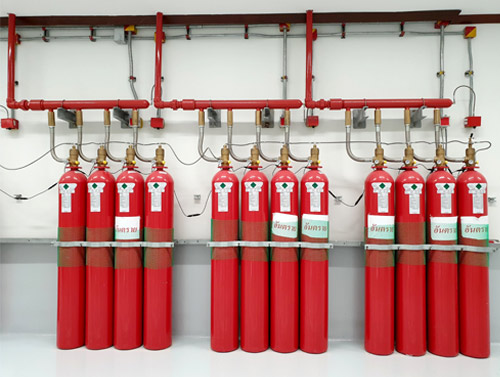
Illustrative gaseous suppression image; the cylinder quantity, agent and discharge arrangement are project-specific.
Review dimensions, equipment, internal partitions, ignition hazards, ventilation and installation constraints.
Assess suitable agents, system application limits, electrical compatibility and supporting product evidence.
Coordinate detection, distribution or tubing, discharge components and the manufacturer’s design requirements.
Define alarms, faults, discharge indication, manual functions and supported fire-alarm or BMS interfaces.
Agree isolation, clearances, manufacturer restrictions, outage needs and installation responsibilities.
Define verification, records, service requirements and review triggers when the panel or operating conditions change.
| Review area | Required inputs |
|---|---|
| Panel configuration | Dimensions, equipment, voltage, partitions, cable entries, door arrangement and electrical clearances. |
| Ventilation and environment | Fans, openings, air paths, temperature, dust, corrosion and occupied surroundings. |
| Suppression equipment | Suitable agent, design quantity, distribution, mounting, components and system application evidence. |
| Controls and operation | Detection, alarms, faults, release logic, electrical isolation interfaces, access and maintenance. |
No. Cabinet protection targets a defined enclosure or equipment volume, while room total flooding protects a specified room enclosure. Their design limits, leakage, agent distribution, controls and occupancy considerations differ and must be established for the selected system.
Suitability must be reviewed. Fans, openings, cable entries, internal obstructions and doors can affect agent delivery and retention. The proposed arrangement must remain within its demonstrated application limits; a sealed-enclosure assumption cannot be applied to every cabinet.
Suppression does not remove the original electrical fault. Agree isolation, investigation and restoration responsibilities with the equipment owner and electrical engineer.
Collect drawings, photographs, equipment details, ventilation and operating constraints.
Review the agent, design basis, manufacturer limits, components, interfaces and approvals.
Coordinate access, electrical precautions, mounting, detection, alarms and agreed commissioning checks.
Provide agreed records and instructions, plan servicing and review panel modifications.
Firetrace’s electrical-cabinet guidance describes localised cabinet protection. UL Solutions’ clean-agent guidance discusses design, installation and maintenance using applicable references and manufacturer instructions.
Confirm the selected system’s evidence, accepted Indian project requirements and authority conditions. These references do not establish a brand partnership or automatic approval for every panel.
Reliance Fire Protection Systems supports panel fire suppression and Fire Safety Audit Services enquiries across all Indian states and union territories. Survey, design and project scope are coordinated from Mumbai according to site hazards, equipment and applicable requirements.
Delhi is a union territory; Delhi NCR also includes locations in neighbouring states. Enquiry coverage does not indicate a local office in each state or union territory.
Our panel fire suppression and Fire Safety Audit Services support covers enquiries for the following industrial zones, IT parks, SEZs, logistics hubs and manufacturing clusters across India. Survey, supply, execution and service arrangements are agreed for each site.
A panel flooding system is a fire suppression arrangement designed for a defined electrical cabinet or enclosure hazard. It may use a suitable extinguishing agent with detection and discharge components selected for the enclosure, equipment, ventilation and accepted design requirements.
No. Cabinet protection targets a defined enclosure or equipment volume, while room total flooding protects a specified room enclosure. Their design limits, leakage, agent distribution, controls and occupancy considerations differ and must be established for the selected system.
Enquiries can cover control cabinets, distribution panels, switchgear enclosures, MCCs, PLC cabinets and other suitable equipment. Voltage, clearances, internal partitions, ventilation, combustible materials and manufacturer restrictions must be reviewed before selection.
There is no universal agent for every panel. Selection depends on the fire hazard, electrical equipment, enclosure, occupied surroundings, environmental conditions and the system’s test or approval scope. Do not assume that all gaseous or aerosol products have the same suitability.
Suitability must be reviewed. Fans, openings, cable entries, internal obstructions and doors can affect agent delivery and retention. The proposed arrangement must remain within its demonstrated application limits; a sealed-enclosure assumption cannot be applied to every cabinet.
No. Fire suppression does not repair damaged equipment or eliminate the original fault. Coordinate isolation or shutdown interfaces with the responsible electrical engineer and equipment owner, and define safe investigation and restoration procedures.
A selected system may use suitable electrical detection, heat-sensitive tubing or another supported arrangement. Detection, release, manual controls, monitoring and alarm functions depend on the exact system and require manufacturer-based design and commissioning.
Suitable alarm, fault, discharge and status interfaces may be included where supported. Define compatible connections, supervision, cause-and-effect logic, power and control responsibilities before integration.
A retrofit requires inspection of panel dimensions, equipment, electrical clearances, ventilation, cable entries, access and operating constraints. Confirm the panel manufacturer’s restrictions, installation method, outage needs and commissioning plan before work.
Follow the approved design and manufacturer instructions. Checks may include cylinders and pressure indication where applicable, agent condition, detection or tubing, discharge components, valves, alarms, faults, interfaces, enclosure changes and service records.
Reliance Fire Protection Systems supports surveys, design coordination, installation, testing, audit and maintenance enquiries from Mumbai across all 28 Indian states and 8 union territories. Product suitability, credentials and service scope are confirmed for each project.
Share the site address, panel type and dimensions, voltage and equipment details, internal photographs or drawings, partitions, ventilation, cable entries, existing alarms, required interfaces and specifications. Call +91 96999 90424 or email sales@relifire.com.
Share panel details, drawings, ventilation, electrical requirements and required scope for review.